

STLinks
TIP
STLinks may be deployed through Profiles and cannot be deployed through the STLinks view at this time.
The STLink software, which facilitates SealedTunnel connections on endpoints, is deployed on or near each endpoint you wish to connect within your environment.
Once deployed, the STLink can route all of your resource connections through the SealedTunnel.
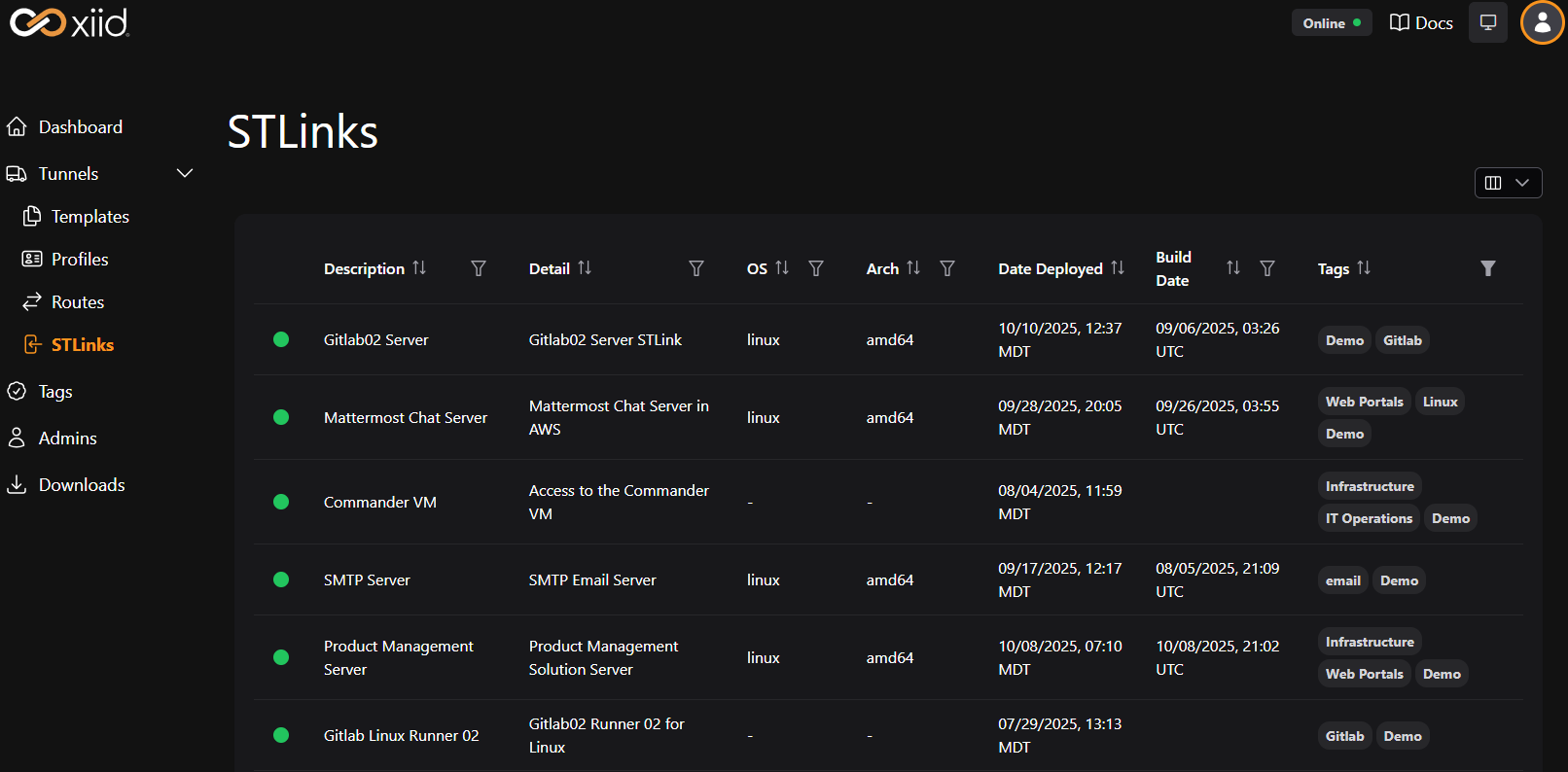
The Commander enables you to deploy and manage the STLinks in your environment through the STLinks view, which can be found under the Tunnels tab group.
STLinks are deployed through Profiles and not through the STLinks view. Rather, after an STLink has been activated using a Profile's Activation Code, the STLink's information will automatically populate in the table in the STLinks view.
You can click on any STLink listed in the table to view additional information about the STLink, enable or disable the STLink, or delete the STLink if it is no longer in use.
The STLinks table has a number of key pieces of information for a variety of purposes. Description and Detail are useful to find a specific STLink when you have a large number deployed in your environment. Last Online and Status are useful to determine what STLinks are stale and which are active. Version and Build Date are useful for identifying which STLinks are up-to-date and which need to be updated.
| Field | Description |
|---|---|
| Status | Indicates when the STLink last made contact with an Xiid Connector (Light Green = currently active, Dark Green = active within last week, Yellow = active within last month, Red = Not active within last month) |
| ID | The auto-generated ID used by the Commander Service to uniquely identify the STLink |
| Description | A description for the STLink - we recommend using information about the machine, such as the hostname |
| Detail | Additional details about the STLink |
| OS | The operating system of the machine where the STLink is deployed |
| Arch | The CPU architecture of the machine where the STLink is deployed |
| Last Online | The date and time when the STLink last contacted an Xiid Connector |
| Date to Auto-Disable | The date and time to disable the STLink (disabled STLinks cannot connect to resources through the SealedTunnel) |
| Delete After Inactivity | The duration in seconds that this STLink can be disconnected before it is deleted from the system |
| Date Deployed | The date and time when the STLink was activated |
| Version | The version of the STLink software running on the machine |
| Build Date | The date that the STLink software running on the machine was built |
| Tags | The Tags assigned to the STLink |
Delete After Inactivity
Once an STLink is deployed, you can set the Auto-delete STLink after inactivity feature in the STLink modal to have the STLink automatically deleted from the environment if it has not connected to the Connector fleet within the specified duration (in seconds). This feature is useful for managing ephemeral STLinks.
Gateway Mode
Gateway mode allows an STLink to operate as a gateway for other devices within the same subnetwork. Gateway mode is a Binding Route setting that operates on top of the STLink. A Gateway Binding is any Binding Route that binds either to 0.0.0.0 or to an exposed network interface (such as eth0 or wlan0). When the Binding Address is defined off an exposed interface, the SealedTunnel becomes available on the designated Binding port to all other devices in the subnet. You can route traffic through the Gateway SealedTunnel by pointing the traffic to the private IP address of the gateway machine and specify the port that the Binding Route is listening on.
Gateway mode is useful when a device needs to communicate through a SealedTunnel but the device cannot have an STLink installed directly on it. A gateway device exposes the SealedTunnel to the secondary device, enabling quantum-resistant encryption and locked down inbound ports on the server-side endpoint.
Reverse Gateway Mode
Reverse Gateway mode allows an STLink to act as a reverse proxy for machines within the subnetwork. A Reverse Gateway is defined by the Mapping Routes and a SealedTunnel is considered a Reverse Gateway when the Mapping Route points to another machine's IP address (technically public or private IP, but you should never use the public IP). In a Reverse Gateway scenario, when a user connects through the Binding Address into a SealedTunnel, the STLink on the receiving end decrypts the traffic and forwards the original payloads to a service listening on a port on a separate host machine.
Reverse Gateway mode is useful for situations in which you have a number of devices within a flat subnetwork and you either don't want to install and manage STLinks on each device (less secure, less preferred) or you cannot install the STLink on devices within the subnetwork. Reverse Gateway mode allows you to interact with devices that otherwise cannot be configured or have third-party software installed on it.